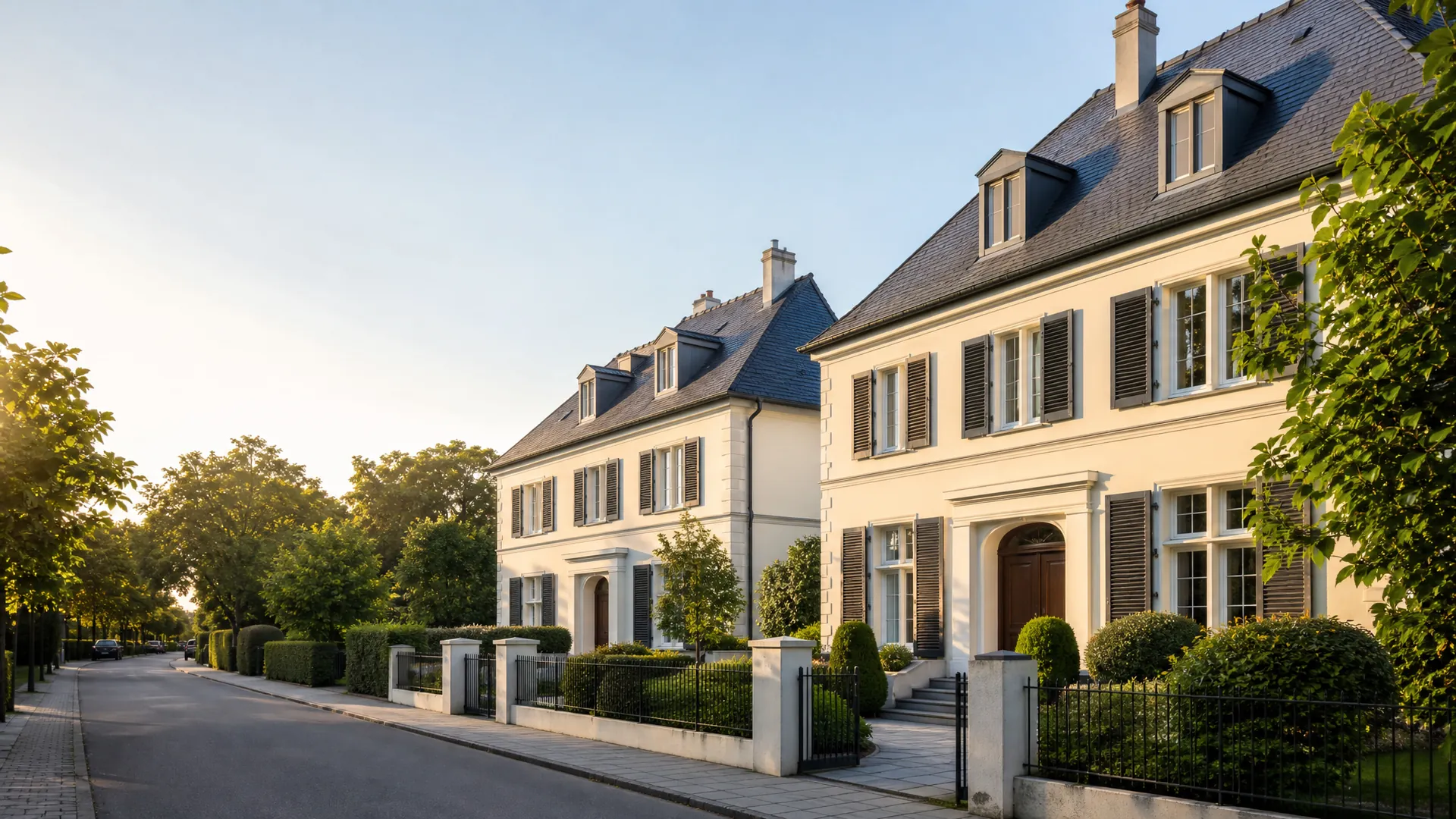
The market value (Verkehrswert) is the legally defined market value of a property and therefore the factual basis for almost every decision relating to purchase, sale, inheritance or financing. But how is it actually determined? This guide explains what lies behind § 194 BauGB, which three standardised methods the Real Estate Valuation Ordinance (ImmoWertV) provides, when each one is used and what role the standard land value (Bodenrichtwert), location and condition play. This will help you understand how a reliable value emerges from data and methodology, especially in a market as varied as Düsseldorf and North Rhine-Westphalia.
What market value under § 194 BauGB really means
The term market value (Verkehrswert) is not a marketing word but a legally defined technical term. Under § 194 of the Federal Building Code (BauGB), the market value (Verkehrswert), synonymous with the market value (Marktwert), is determined by the price that, on the valuation date in ordinary business dealings, could be achieved according to the legal circumstances and actual characteristics, the general condition and the location of the property, and without regard to any unusual or personal circumstances.
Three important points for practice follow from this definition:
- Objective standard: what counts is the price achievable under normal market conditions, not a personal wishful or distress price.
- Reference to a fixed date: the value always applies to a specific day. Market movements before or after are disregarded.
- No personal circumstances: time pressure, divorce or the settlement of an estate must not influence the determined value.
The market value (Verkehrswert) is thus the neutral reference value. How it is derived in concrete terms is governed by the Real Estate Valuation Ordinance (ImmoWertV), which has applied in its current version since 1 January 2022.
The three ImmoWertV methods at a glance
In § 6, the ImmoWertV names three standardised valuation methods. They can be applied individually or in combination, depending on which data are available and meaningful on the market for the property in question:
- Comparative value method (Vergleichswertverfahren): the value is derived from prices actually paid for comparable properties. It is the method closest to the market because it ties directly to real transactions.
- Income value method (Ertragswertverfahren): the value results from the sustainably achievable rental income, less the management costs and capitalised using the property interest rate (Liegenschaftszinssatz). Here the yield is the focus.
- Asset value method (Sachwertverfahren): the value is determined from the construction costs of the building less depreciation for age, plus the land value, and then adjusted to the market with an asset value factor (Sachwertfaktor).
The ordinance does not prescribe a rigid assignment but requires the customary and appropriate method. In practice, a result is often plausibility-checked with a second method, for example an asset value additionally verified against comparative data.
When each method is appropriate
Which of the three methods takes the lead depends above all on the type of property and the data situation. A rough orientation:
- Comparative value method (Vergleichswertverfahren) for condominiums, terraced houses, semi-detached houses and single-family homes in common locations as well as for building plots. The prerequisite is a sufficient number of comparable sales. In densely traded Düsseldorf districts such data are usually available.
- Income value method (Ertragswertverfahren) for investment properties such as apartment buildings, residential and commercial buildings as well as commercial properties, where the earning power determines the price.
- Asset value method (Sachwertverfahren) for rarely traded or special properties, such as detached single-family homes in thinly traded markets, villas, one-of-a-kind buildings or special-use properties, when reliable comparative or income data are lacking.
For owner-occupied single-family homes, the comparative and asset value methods are often combined in practice to offset a missing data basis and to safeguard the result.
Standard land value (Bodenrichtwert) and BORIS NRW as the data foundation
In all three methods, the land value (Bodenwert) is a central building block. Its most important basis is the standard land value (Bodenrichtwert): an average location value of the land in euros per square metre for a zone with largely uniform use and value conditions. It is derived by the official expert committees for property values (Gutachterausschüsse) from their collection of purchase prices, into which all notarised purchase contracts flow.
In North Rhine-Westphalia these values can be retrieved via the official portal BORIS NRW (boris.nrw.de). There, alongside the standard land value (Bodenrichtwert) for their plot, owners and buyers also find market reports and further data from the expert committees.
Correct classification is important: the standard land value (Bodenrichtwert) refers to a fictitious, typical plot in the zone. It is an average and orientation value, not a finished plot value. Layout, corner position, slope, infrastructure, buildability or encumbrances can require substantial additions or deductions. The standard land value (Bodenrichtwert) therefore does not replace a concrete valuation; it is its starting point.
Which factors specifically shape the market value
Within the methods, the individual characteristics of a property are taken into account via rents, factors or additions and deductions. The key value-forming influences are:
- Location: macro-location (city, region, economic strength) and micro-location (neighbourhood, transport links, local amenities, noise, surroundings) are among the strongest value drivers.
- Plot: size, layout and the building rights derived from them.
- Year of construction and method of construction: building age class, solid or lightweight construction, basement.
- Condition and modernisation: a backlog of maintenance reduces the value, while a renewed heating system, windows, roof or bathrooms increase it and extend the remaining useful life.
- Fit-out standard: from simple to high-end, for example floor coverings, sanitary fittings, balcony or lift.
- Living space and floor plan: correctly determined according to the Living Space Ordinance (Wohnflächenverordnung), functionality and natural lighting of the rooms.
- Energy efficiency: the energy rating and type of heating increasingly affect demand and price.
- Legal circumstances: entries in the land register such as rights of way or residence, usufruct, hereditary building rights as well as listed-building status.
It is precisely this level of detail that distinguishes a sound valuation from a blanket estimate.
Market value, asking price and purchase price are not the same
Three terms are often confused in everyday use, although they mean different things:
- Market value (Verkehrswert): the legally defined, objectively derived market value under § 194 BauGB. It is the factual reference figure.
- Asking price: the seller's price demand in the listing. It is chosen strategically and may deliberately be above or below the market value (Verkehrswert). Listing prices are therefore not a reliable measure of value.
- Purchase price: the actual negotiation result. It can exceed the market value (Verkehrswert), for example when demand and bidding interest are strong, or fall below it, for example with a renovation backlog. Notarised purchase prices in turn flow into the collection of purchase prices and thus shape future standard values.
For practice this means: a realistic asking price should be guided by the determined market value (Verkehrswert) and by current market activity, not by wishful thinking. Entering too high often lengthens the marketing period, entering too low gives away substance.
Process: self-estimate, market appraisal or expert report
Depending on the occasion and the reliability required, there are three routes to the market value (Verkehrswert), which differ markedly in depth and robustness.
1. Self-estimate with online calculators: fast and usually free, they provide a rough initial orientation, often as a range. They are frequently based on listing data rather than real purchase prices and barely take into account particularities such as structural defects, micro-location or land register rights. They are not suitable as a robust basis for important decisions.
2. Professional market appraisal: it combines local market knowledge with comparative data and an inspection of the property. It is the appropriate starting point for assessing a realistic asking price and the chances of sale. However, it is not a court-proof expert report.
3. Market value expert report under § 194 BauGB: it is prepared by qualified experts, comprises an on-site inspection, examination of the legal circumstances and the comprehensible application of the ImmoWertV methods. Typical documents are the land register extract, cadastral map, living space calculation, floor plans, building description and energy certificate. Such a full expert report is sensible above all for legally or fiscally significant occasions, for example before a court, the tax office or in the settlement of an estate.
Richter Immobilien-Transaktionen offers, as a sound starting point, a well-founded, free and non-binding market appraisal for your property in Düsseldorf and NRW. It draws on many years of market knowledge and a network grown over decades with more than 20,000 contacts, and gives you a realistic orientation before you decide on the next steps.