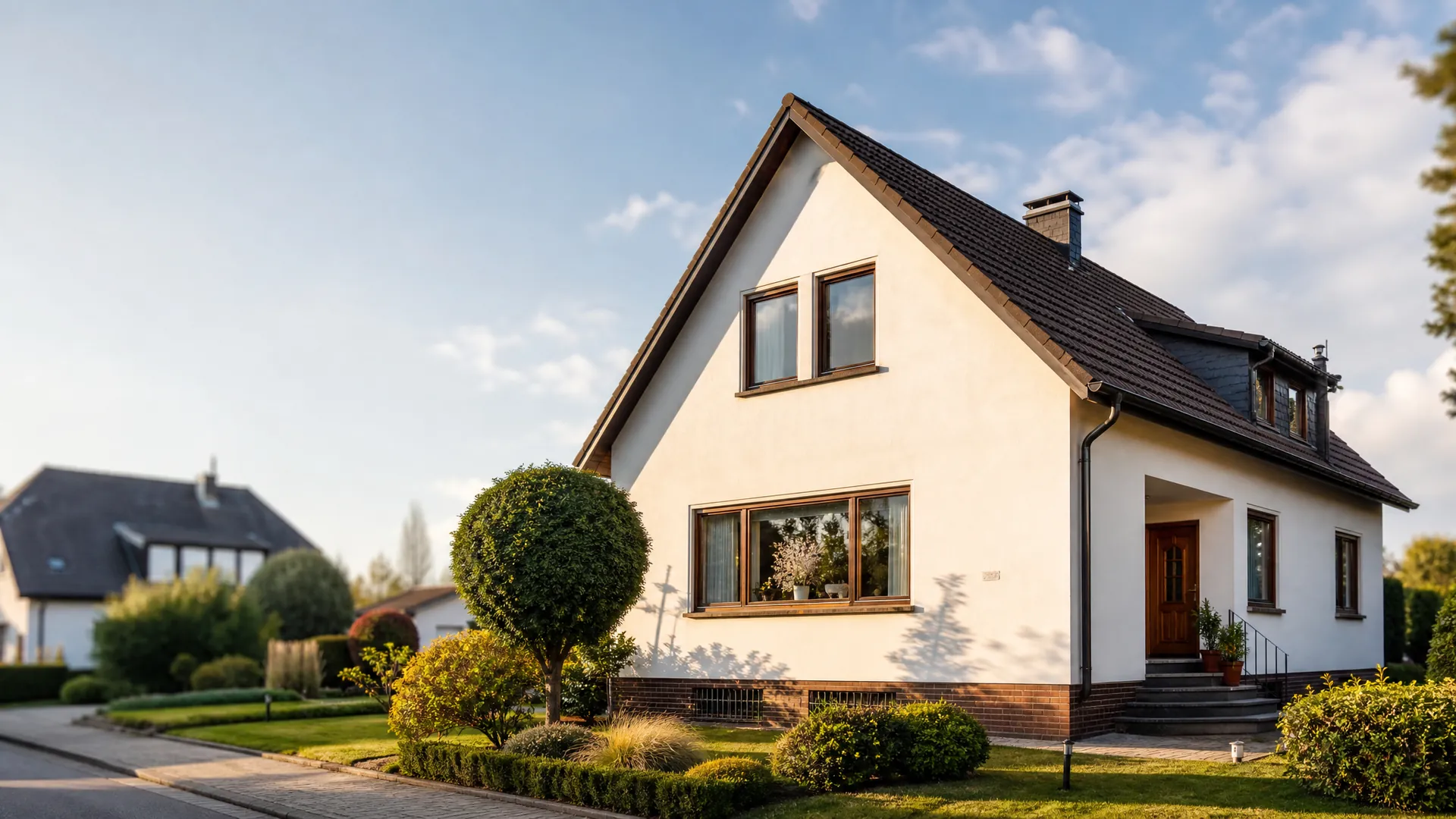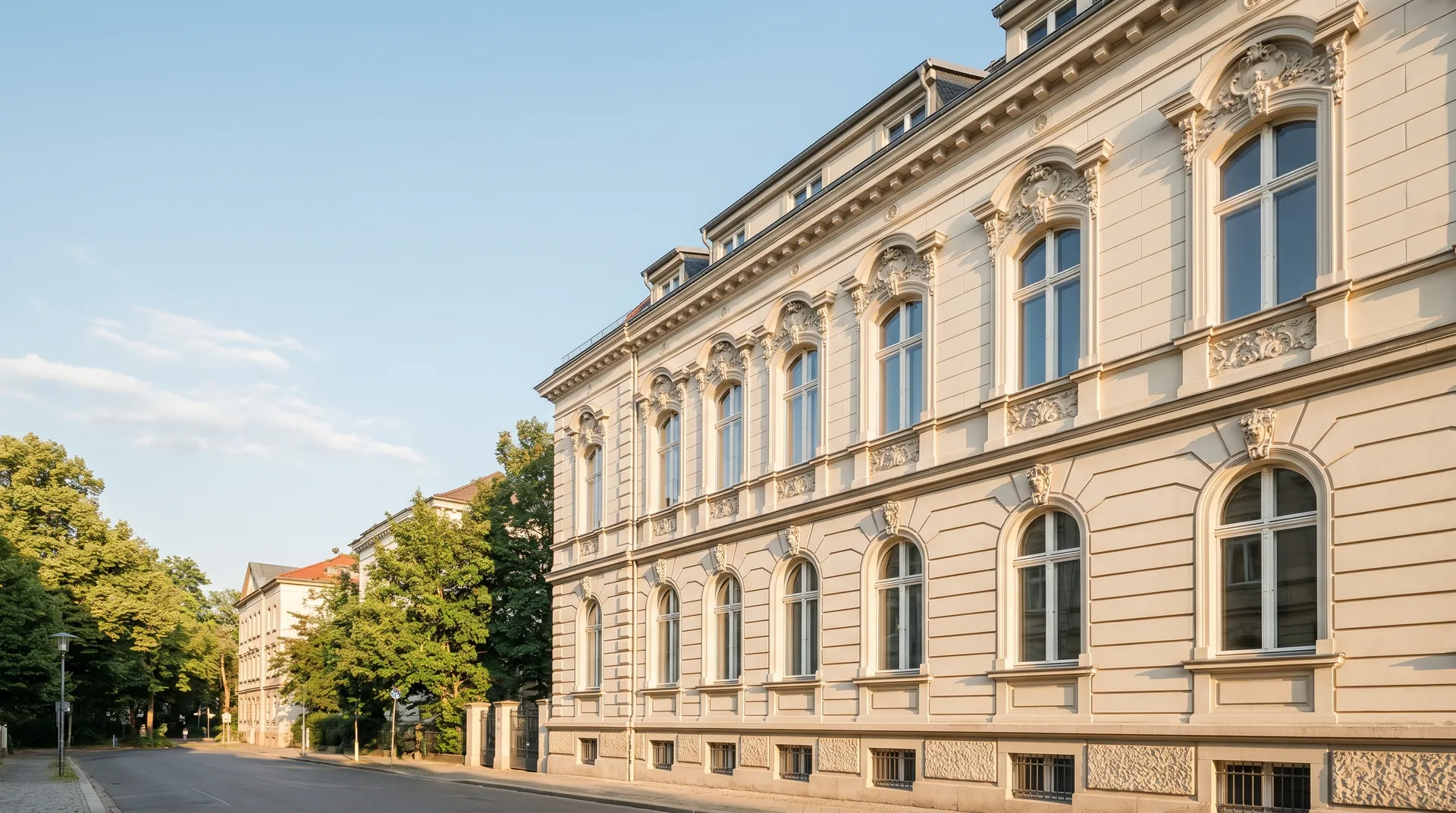
Buying a heritage-protected property means taking on a piece of history, with special charm but also with special rules. Those who plan correctly here can benefit from considerable tax advantages, but must observe duties towards the heritage authority and coordinate renovations in advance. We have been at home in the Düsseldorf property market and also appraise and broker heritage objects in Düsseldorf and North Rhine-Westphalia. This guide explains to you calmly and comprehensibly what heritage protection (Denkmalschutz) means, which duties and tax benefits await you and what you should consider before buying.
What does heritage protection mean?
A property is under heritage protection (Denkmalschutz) when there is a public interest in its preservation, for example on historical, artistic, scientific or urban-planning grounds. Decisive in North Rhine-Westphalia is the Heritage Protection Act NRW (DSchG NRW) in the version in force since 2022.
A building acquires this legal status through entry in the heritage register (§ 23 DSchG NRW), which is maintained by the Lower Heritage Authority. Only with this entry does an architectural monument formally count as protected. The authorities are advised on technical matters by the heritage conservation offices of the regional associations (LVR in the Rhineland, LWL in Westphalia-Lippe).
A distinction is drawn, among other things, between the architectural monument (the individual protected building), the heritage area (a protected overall complex or ensemble, where the external appearance matters above all) and ground or garden monuments. For buyers of a residential property, the architectural monument is usually the relevant one.
What duties does the owner have?
With ownership of an architectural monument you take on two central duties towards the heritage authority.
- Maintenance duty (§ 7 DSchG NRW): Owners and authorised users must preserve their architectural monuments in a heritage-appropriate manner within the bounds of what is reasonable, keep them in repair, treat them properly and protect them from endangerment. The standard of reasonableness limits the duty but does not abolish it.
- Approval requirement (§ 9 DSchG NRW): Anyone wishing to alter, remove, relocate to another site or change the use of an architectural monument requires the permission of the heritage authority. This also applies to modernisations, new windows, roof work or the installation of a heating system when these affect the heritage value.
In practice this means: you cannot build freely on an architectural monument as you would on an ordinary property. Every substantial measure must be applied for and approved beforehand. Anyone working without permission risks not only an administrative offence but also the loss of the tax incentive.
Tax benefit for landlords: listed-building depreciation under §§ 7i and 7h EStG
The probably best-known advantage of heritage-protected properties is the enhanced depreciation, the so-called listed-building depreciation (Denkmal-AfA). It makes it possible to write off the renovation costs for tax purposes considerably faster than with a normal older building.
For rented architectural monuments, § 7i EStG applies: in the year of completion and in the following seven years, up to 9 percent of the eligible production costs may be deducted each year, and in the following four years up to 7 percent each year. Over these twelve years, up to 100 percent of the eligible costs can thus be written off.
Very important and often misunderstood: Only the renovation or production costs coordinated with the heritage authority are eligible, not the purchase price and not the old-building share. For the acquisition price attributable to the existing building, only the regular building depreciation under § 7 paragraph 4 EStG continues to apply (as a rule 2 or 2.5 percent annually). Own labour and outdoor facilities are not eligible.
A comparable incentive with the same rates is provided by § 7h EStG for buildings in formally designated redevelopment areas and urban development zones. The difference lies in the legal basis: § 7i requires a registered architectural monument, § 7h a building in a redevelopment area; there the certificate is issued by the municipality.
Tax benefit for owner-occupiers: § 10f EStG and maintenance expenditure under § 11b EStG
Anyone who occupies an architectural monument themselves is also supported, but by a different route. Under § 10f EStG owner-occupiers can deduct the eligible expenditure in the year of completion of the building measure and in the following nine years, up to 9 percent each year, as special expenses. Over ten years that amounts to up to 90 percent of the eligible costs.
The prerequisite is that the measures meet the requirements of § 7i (architectural monument) or § 7h (redevelopment area) and that you use the building for your own residential purposes in the respective years. As a rule, you can only claim the deduction under § 10f for one building, and for spouses, under the statutory conditions, for two buildings.
In addition to these enhanced deductions there is a further relief: pure maintenance expenditure on an architectural monument can, under § 11b EStG, be spread evenly over two to five years if the measures are heritage-appropriate and coordinated with the authority. Here too, as with the depreciation, only the eligible, certified measures count, not the purchase price.
Certificate and incentive: no tax benefit without coordination
All of the tax benefits mentioned have a common, mandatory prerequisite: a certificate from the heritage authority. In NRW, § 36 DSchG NRW is decisive for this. The certificate proves to the tax office that the property is an architectural monument and that the expenditure was necessary for preservation or sensible use.
The chronological order is decisive: the measures must be coordinated with the heritage authority before they begin. The Income Tax Act expressly stipulates this. Anyone renovating without prior coordination risks the authority not certifying the costs as heritage-appropriate, and the tax office is bound by the certificate. Without coordination and a certificate there is no enhanced depreciation.
In addition to the tax incentive, further support may be considered depending on the object: low-interest loans and grants via the KfW and the NRW.BANK, grants from the Deutsche Stiftung Denkmalschutz as well as the heritage funding of the State of NRW. These programmes are often combinable, but mostly have to be applied for before the measures begin. Grants received reduce the tax-privileged assessment basis.
Advantages and disadvantages at a glance
An architectural monument is a special property, with clear strengths and equally clear requirements. An honest weighing-up is part of every purchase decision.
Advantages:
- Considerable tax incentive for the coordinated renovation costs via the listed-building depreciation (§§ 7i, 7h, 10f, 11b EStG).
- Architectural character, high-quality building fabric and often sought-after, established locations.
- Access to supplementary funding programmes from the federal government, the states and foundations.
Disadvantages and risks:
- Renovations require approval and must be carried out in a heritage-appropriate manner, which can be more demanding and more expensive.
- Limited scope for design when making changes and modernising.
- Maintenance duty and ongoing upkeep effort; the renovation costs are harder to calculate in advance than for a new build.
Process: what buyers should consider before buying
When buying an architectural monument, thorough preparation pays off. The following process has proven its worth:
- Check the status: Clarify through the Lower Heritage Authority whether and since when the object is entered in the heritage register and which parts are protected.
- Enquire about conditions: Have existing conditions, earlier approvals and heritage-conservation requirements set out for you.
- Determine condition and renovation costs: Bring in expert surveyors for older fabric and calculate the expected heritage-appropriate renovation costs realistically.
- Coordinate measures in advance: Coordinate planned renovations with the heritage authority before the purchase or before construction begins; this is the basis for the later certificate and the tax benefits.
- Clarify funding and tax: Examine suitable funding programmes in good time. Your personal tax situation, such as the split into eligible and non-eligible costs, is assessed in detail by your tax adviser.
With a presence in the Düsseldorf market and a network grown over the decades with more than 20,000 contacts, we classify heritage objects in Düsseldorf and NRW realistically, from the first assessment to the brokerage, calmly and without sales pressure.
If you already own a historic property, our guide to selling a listed house explains how to prepare the heritage records, maintenance information and answers buyers need.