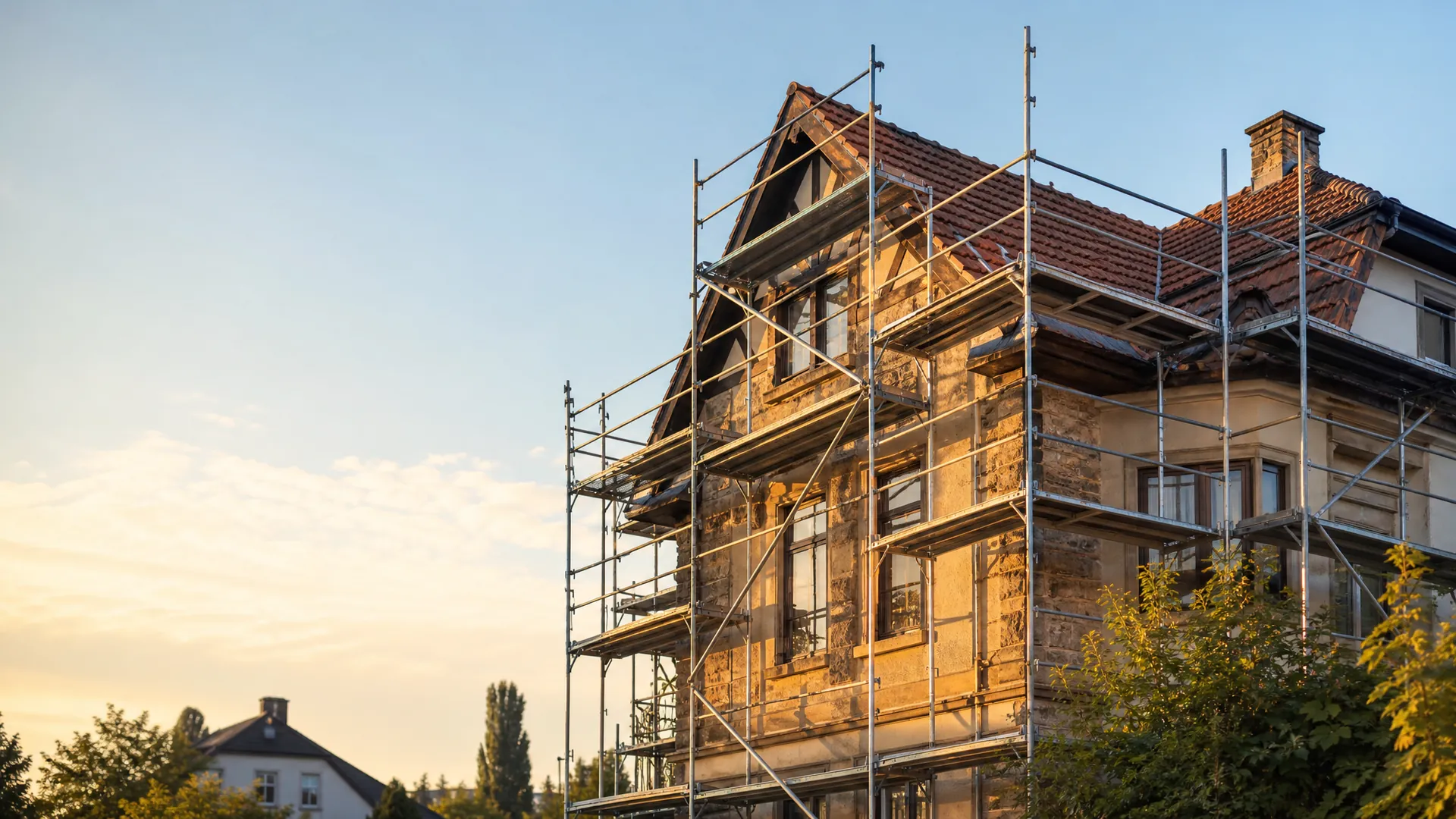
Repair and modernisation needs deferred over the years often add up unnoticed – until the roof, heating or wiring all call for investment at the same time. This is exactly what the term renovation backlog (Sanierungsstau) describes. For owners it is decisive when selling, because it influences the achievable price, the negotiation and the legal duties on a change of owner. We explain to you in plain terms how to recognise a renovation backlog, what it means for the value of your property, which modernisation duties the Buildings Energy Act (GEG) provides for, and how to weigh up renovating against selling in the current condition.
Are you considering selling this property? Discuss your sale with us
What does renovation backlog mean?
One speaks of a renovation backlog (Sanierungsstau) – often also called a maintenance or modernisation backlog – when necessary repairs, restorations and modernisations have been left undone on a property over a longer period and the resulting need has piled up. What is meant is not individual cosmetic repairs, but above all substantial and functional defects in building components and building services that involve a noticeable need for investment.
The term is shaped by economics and building technology; it is not an independent legal term. In valuation, however, the costs of clearing a renovation backlog are regularly taken into account as a value-reducing factor. It is typical for technical deficits and energy weaknesses to coincide: an old heating system, uninsulated components and windows that have aged cause not only a need for repair but also high energy costs. Anyone who assesses the condition of their property early and honestly can plan more precisely when selling.
Typical problem areas – how to recognise a renovation backlog
A renovation backlog rarely shows up in a single place. Experience shows these areas are the most important indicators:
- Roof: water stains on ceilings or in the loft, damaged or slipped tiles, a missing or porous sub-roof membrane, corroded gutters and downpipes as well as inadequate insulation point to a need for action.
- Heating and building services: a very old heat generator, high consumption, uneven heat distribution, frequent faults and outdated control technology are clear warning signs. The age of the boiler is particularly telling here.
- Wiring: old screw fuses, a missing residual-current circuit breaker, too few sockets, visible makeshift solutions and recurring outages indicate a system in need of overhaul.
- Windows: draughts, condensation, fogged panes between the glass layers, brittle seals and stiff fittings point to high heat losses.
- Facade and insulation: flaking render, cracks, cold interior walls, thermal bridges and high heating costs are typical signs of missing or inadequate insulation.
- Damp and cellar: a musty smell, mould, salt efflorescence, damp plinth areas and wet cellar walls point to moisture problems that should be taken seriously.
- Pipes and lines: corrosion, pressure drops, discolouration of the water, lime deposits, leaks and uninsulated pipes in unheated rooms are further clues.
If several of these points occur together, experience shows there is a relevant renovation backlog.
Consequences for value and sale price
A renovation backlog has an effect on two levels: on the achievable price and on the marketing period. Buyers factor in the renovation costs to be expected, the risk of hidden defects and the time required for the work – and deduct these points from the price. In market-value assessment the costs of clearing the defects are often taken into account directly as value-reducing.
There are deliberately no flat-rate percentages. How large the discount turns out to be depends on the scope and urgency of the measures, on the location and on the local market environment. The larger the interventions on the roof, heating, wiring or in the case of moisture damage, the more strongly this also affects financability for buyers – and the longer the marketing can take. At the same time, in Düsseldorf and in many locations in North Rhine-Westphalia there is a noticeable demand for properties with development potential. What is decisive is a realistic, comprehensible valuation: anyone who presents the condition transparently achieves, in our experience, more stable results than with an inflated entry price that later has to be corrected.
Renovation backlog when buying: negotiation, surveyor and reserve
From the buyer's point of view, a renovation backlog is initially a negotiating topic. A negotiation is sound when it is based on reliable figures – for example concrete cost estimates or a survey. Flat-rate estimates, by contrast, are easy to challenge.
- Surveyors and experts: an independent building survey helps to identify hidden defects and follow-up costs – especially with the roof, cellar, damp, wiring and heating. In this way the renovation need can be quantified seriously.
- Maintenance reserve for condominiums: when buying an apartment within an owners' association, it is worth looking at the maintenance reserve (Erhaltungsrücklage). Under Section 19 of the Condominium Act (§ 19 WEG), the proper upkeep of the common property and the accumulation of an appropriate maintenance reserve are part of proper administration. If the reserve is too low, special levies loom when larger measures are due.
- Check the documents: minutes of the owners' meetings, the business plan, service-charge statements and any arrears give indications of a renovation backlog in the common property and of the financial situation of the association.
For sellers, conversely, the following applies: anyone who communicates defects openly and backs them up with documents creates trust and often shortens the negotiation.
Energy requirements: GModG replaces the former GEG rules
The Building Modernisation Act (GModG) has applied since 29 July 2026. Former sections 47, 48, 71 and 72 GEG have been repealed. The blanket 65-percent requirement for new heating systems and the former age-based operating prohibition can therefore no longer be derived from those provisions. Sale planning should use the current law rather than an older checklist.
Energy requirements still apply. Section 36 GModG now covers alterations to external building components, while section 69 addresses heating and hot-water pipes. It also specifies when a two-year period applies after a change of ownership. The actual work required depends on the building, its components and the conditions of the relevant provision. Have the condition, technical requirements and costs assessed for the particular property.
Heating, the energy certificate and your sale
The amended law allows greater flexibility when choosing a heating system. This does not remove all operating requirements: the GModG also contains provisions on fuels and newly installed systems. Before investing, consider suitable technology, running costs and the intended period of use together. A sale alone is no reason to order a replacement system prematurely.
The energy performance certificate remains important when selling. Under section 80 GModG, it generally has to be presented by the viewing and handed over after the purchase contract; statutory exceptions require separate consideration. It helps buyers understand the energy condition. Records of modernisation, maintenance and known weaknesses add useful context.
Renovate or sell in the current condition – and how we accompany you
Whether a renovation before the sale is worthwhile cannot be answered across the board. Renovating speaks for itself when targeted measures clearly improve the achievable price and the circle of buyers and the investment is in proportion. Selling in the current condition speaks for itself when the effort is high, the result uncertain or time is short – because many buyers want to renovate to their own ideas anyway and factor that in. Often, selling in the current condition is the clearer and lower-risk route, because you do not have to make an advance outlay and do not have to give a guarantee for the success of individual measures.
We assess your property realistically – even when there is a renovation backlog. We neither talk the condition up nor down, but classify it comprehensibly and show you the options. As an arm of Wolfgang Richter GmbH, we have accompanied owners in the Düsseldorf and North Rhine-Westphalian market . Over the years, a grown network with more than 20,000 contacts has emerged, which helps us to bring properties and suitable interested parties together discreetly – on request also in a confidential marketing away from the large portals. Whether selling in the current condition or an accompanied route: we take every step together with you.
If selling is an alternative to carrying out the renovation yourself, compare costs and possible proceeds for both routes. Selling a house that needs renovation covers condition records, defect disclosures and pricing.