For many homeowners in Düsseldorf and across NRW, a photovoltaic system has now become standard equipment – whether to cut electricity costs, become more independent, or make their own property future-proof. But what does a PV system actually cost, and from when does it pay off? In this guide we put the prices in honest perspective: guide values per kWp, the individual cost components, the role of a battery storage unit, the running costs and the tax advantages. Since, as estate agents, we deal daily with the energy profile of properties, at the end we also explain how a solar system can affect the value of a house. All price figures are realistic ranges – the spread on the market is considerable.
What does a PV system cost for a detached house?
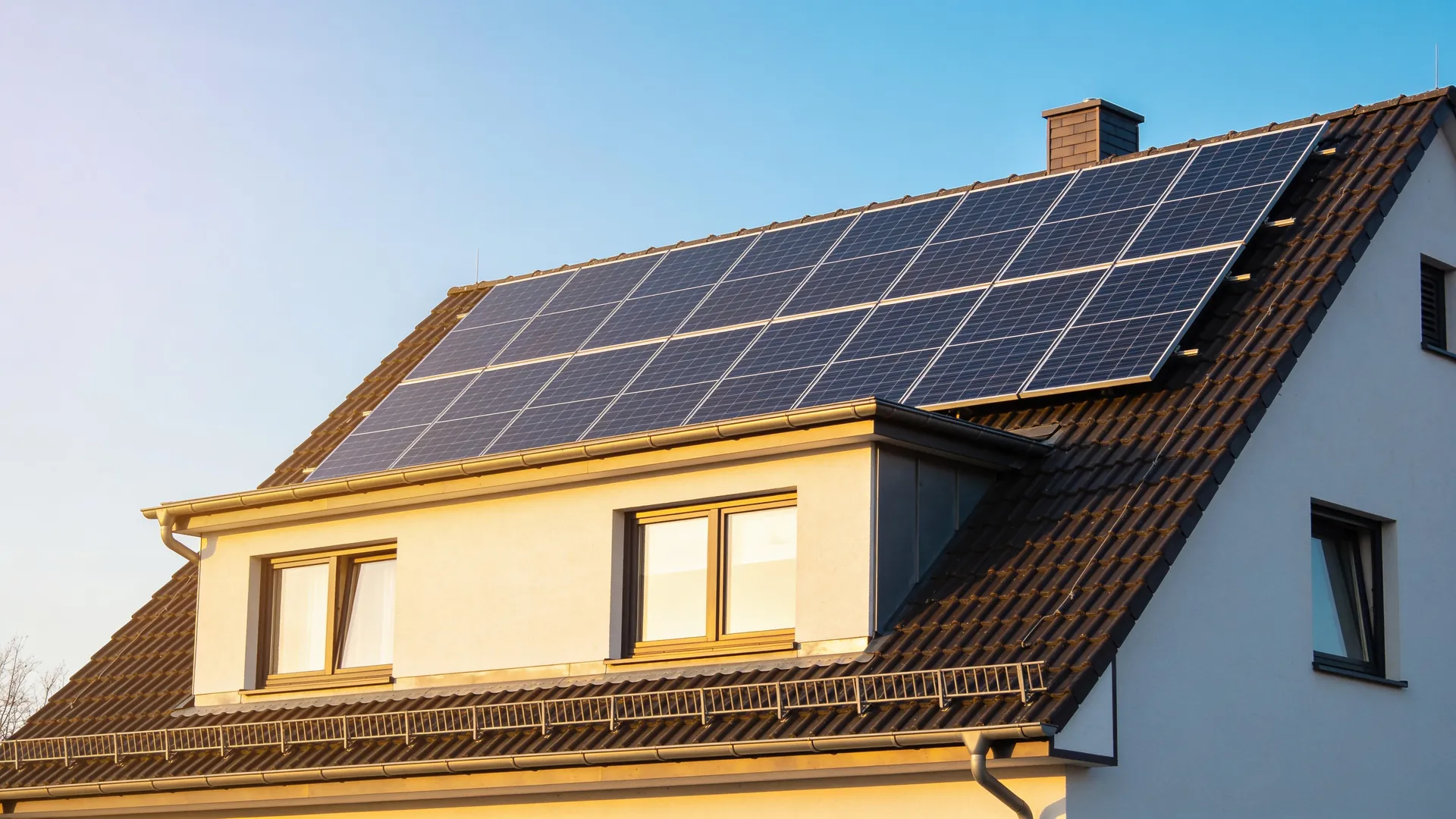
The costs of a photovoltaic system are usually stated in euros per kilowatt-peak (kWp). Kilowatt-peak describes the maximum output of the system under standard conditions and is the most important comparison figure. For a typical detached house, a system size of around 5 to 10 kWp is usually installed today, often in the range of 8 to 10 kWp.
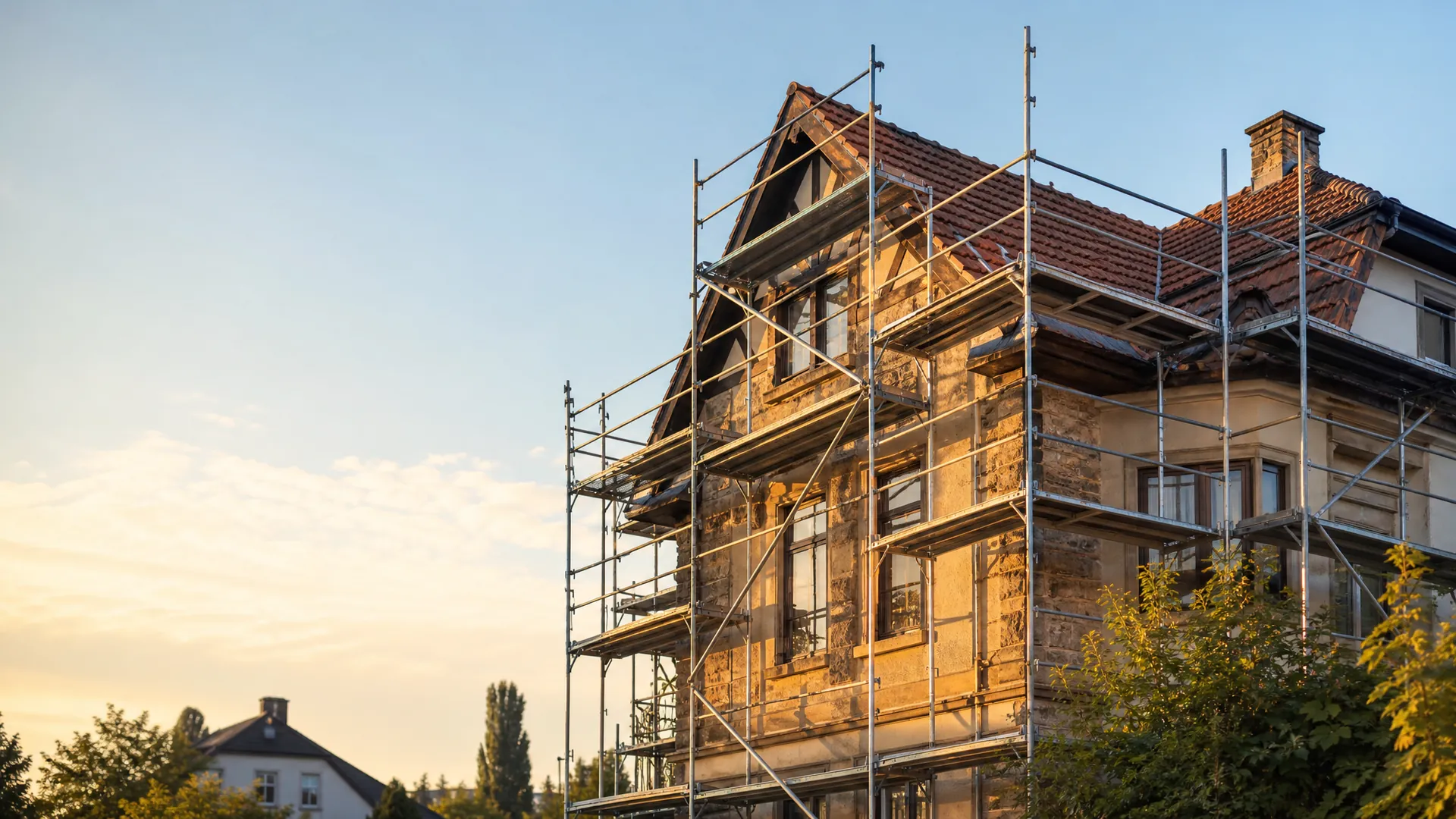
Turnkey rooftop systems without storage currently fall roughly within a range of around 1,000 to 1,700 euros per kWp, with reputable offers for medium sizes frequently between about 1,100 and 1,500 euros per kWp. For a detached house this results, depending on size, roof shape and region, in a complete price of around 9,000 to 16,000 euros without storage. These figures are guide values: factors such as roof pitch, shading, number of modules, the effort for scaffolding and electrics as well as regional demand lead to significant price differences. We recommend always obtaining several offers and paying attention to the price per kWp.
With or without battery storage – what does the difference cost?
A battery storage unit noticeably increases the investment but raises the share of self-consumed electricity. Without storage, the self-consumption of an average household is usually around 25 to 35 percent of the energy generated – the rest is fed into the grid. With an appropriately sized storage unit, self-consumption can often be increased to 50 to 70 percent, because electricity generated during the day remains available in the evening and at night.
For a detached house, storage units with 5 to 10 kWh of usable capacity are typically installed. The costs for this are, including installation, roughly 400 to 800 euros per kilowatt-hour of storage capacity, with good offers tending toward the lower range. In practice, for a system with 8 to 10 kWp and 8 to 10 kWh of storage, this means a total price of around 14,000 to 23,000 euros, with many offers between roughly 14,000 and 20,000 euros. Whether storage is worthwhile depends on the electricity consumption, the consumption profile and the storage price – there is no blanket answer.
The cost components at a glance
The total price of a PV system is made up of several components. For a rooftop system without storage, the costs roughly break down as follows:
- Modules: around 30 to 40 percent of the total costs – the heart of the system, which generates electricity from sunlight.
- Inverter: about 10 to 15 percent – it converts the generated direct current into usable alternating current.
- Installation, mounting structure, electrics and planning: in total around 30 to 40 percent, a considerable share for the trade work and commissioning.
- Other: about 10 to 15 percent for wiring, surge protection, meter adjustment and small materials.
If a battery storage unit is added, the shares shift: the storage including installation then often makes up 25 to 40 percent of the total price, while the remaining items recede correspondingly in percentage terms. These shares are typical guide values and fluctuate depending on the manufacturer, system size and local conditions.
Running costs and payback
After installation, a PV system causes only manageable running costs. For a detached house, owners should roughly reckon with the following annual items:
- Insurance: often 30 to 100 euros per year, depending on whether the system is included in the residential building insurance or insured separately.
- Maintenance, cleaning and minor repairs: around 150 to 300 euros per year, or as a reserve.
- Metering point operation or smart meter: depending on requirements, up to around 100 euros per year.
- Reserves for inverter and storage: sensible, since the inverter is typically replaced after 10 to 15 years.
Economically, a system pays off above all through avoided electricity purchases: self-generated electricity costs significantly less than electricity from the grid for small systems. The payback period for well-planned systems without storage is frequently around 8 to 12 years, with storage rather 10 to 15 years. With service lives of 20 years and more, an economic advantage therefore usually remains – provided that self-consumption and offer price are right. The actual profitability is always a case-by-case calculation; binding return promises cannot be given responsibly.
Feed-in tariff under the EEG
Electricity that you do not consume yourself is fed into the public grid and remunerated under the Renewable Energy Sources Act (EEG). The rates are set by the Federal Network Agency (Bundesnetzagentur) and adjusted regularly – currently every six months. For newly commissioned systems up to 10 kWp, the following values have applied since 1 February 2026:
- Partial feed-in (self-consumption plus surplus feed-in): around 7.8 cents per kilowatt-hour.
- Full feed-in (no self-consumption): around 12.3 cents per kilowatt-hour.
The remuneration is paid for 20 years from commissioning plus the year of commissioning and remains constant for the respective system. Important to understand: the feed-in tariff today is mostly no longer the main driver of economic viability – the decisive factor is self-consumption, because self-used electricity replaces the more expensive grid supply. The rates mentioned are the current values; they can change with future adjustments.
0% VAT and tax exemption
When buying a PV system, private owners benefit from two considerable tax reliefs.
Firstly, since 1 January 2023 a zero VAT rate applies under § 12 (3) UStG: the supply and installation of a photovoltaic system together with its essential components – including battery storage – is subject to 0 percent VAT if the system is installed on or near residential buildings, public buildings or buildings serving the common good. In practice this means: net and gross price are identical. For systems up to 30 kWp on residential buildings, the favoured use is assumed without further proof.
Secondly, the income from operating small systems is exempt from income tax under § 3 No. 72 EStG – retroactively since 1 January 2022. Favoured are systems up to 30 kWp on detached houses and other buildings, as well as up to 15 kWp per residential or commercial unit in larger buildings, up to a total of 100 kWp per taxpayer. Thus both the feed-in tariff and self-consumption are exempt from income tax; a profit determination for the PV system alone is generally no longer required. Registration in the Market Master Data Register (Marktstammdatenregister), however, remains mandatory. This is general information and does not replace tax advice in an individual case.
Photovoltaics and property value – when we come into play
A photovoltaic system changes the energy profile of a property – and it is precisely this profile that is increasingly coming to the fore when buying and selling. Low energy costs, a good energy performance certificate and future-proof equipment are real arguments for many buyers in Düsseldorf and NRW today. An existing, professionally installed and documented solar system can increase the attractiveness of a house on the market and make marketing easier.
However, it is not possible to state in blanket terms by what amount a PV system increases the market value – this depends on age, condition, remaining term of the feed-in tariff, the overall condition of the property and the respective buyer demand. As estate agents, we place such factors in the overall picture: we consider energy equipment, location and substance together and position your property factually on the market. If you are considering how an existing or planned solar system affects the value and marketing of your house, please feel free to contact us.
When an existing installation is part of a property sale, our guide to selling a house with solar panels explains how to organise ownership, contracts and the operator change.