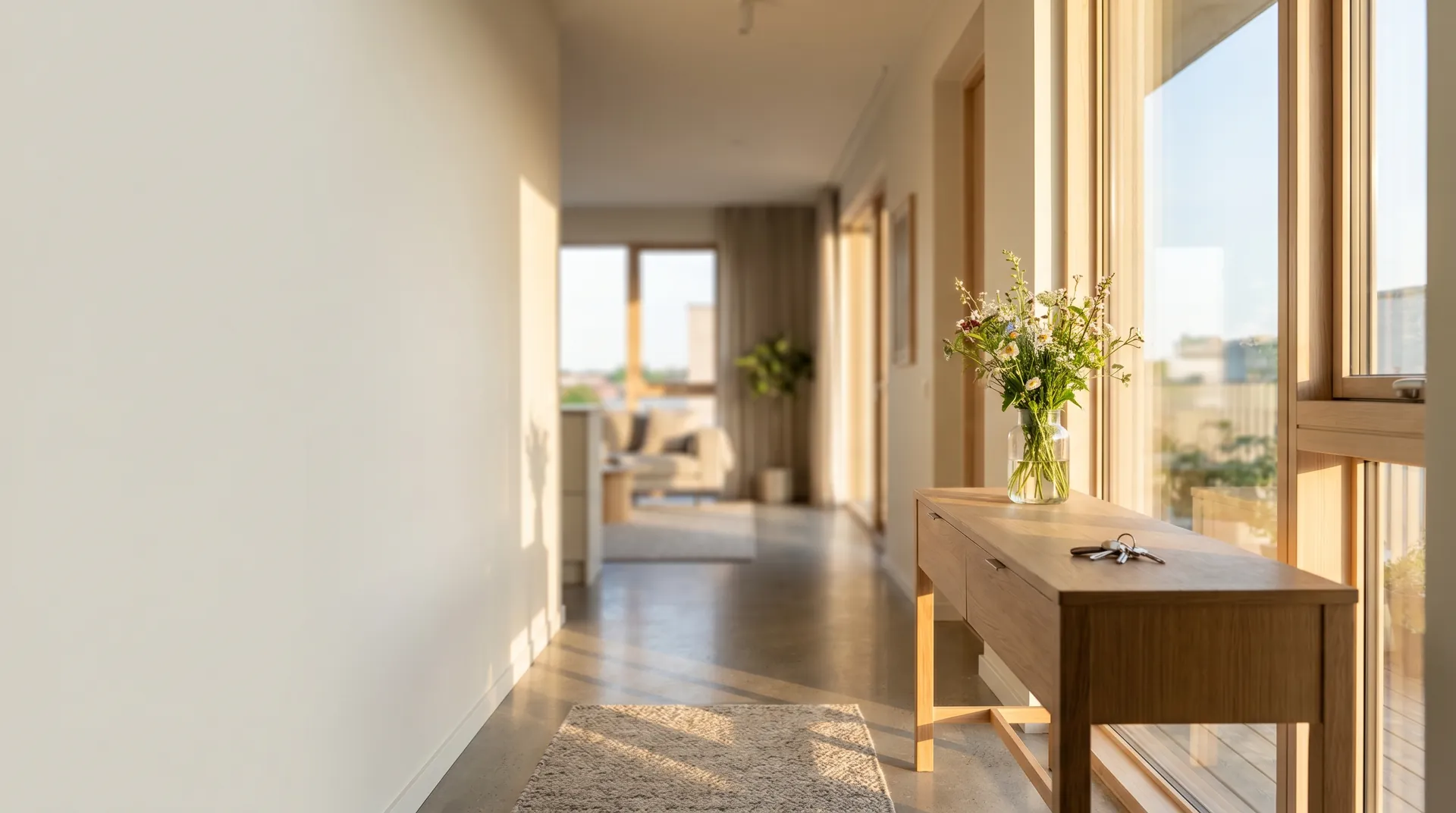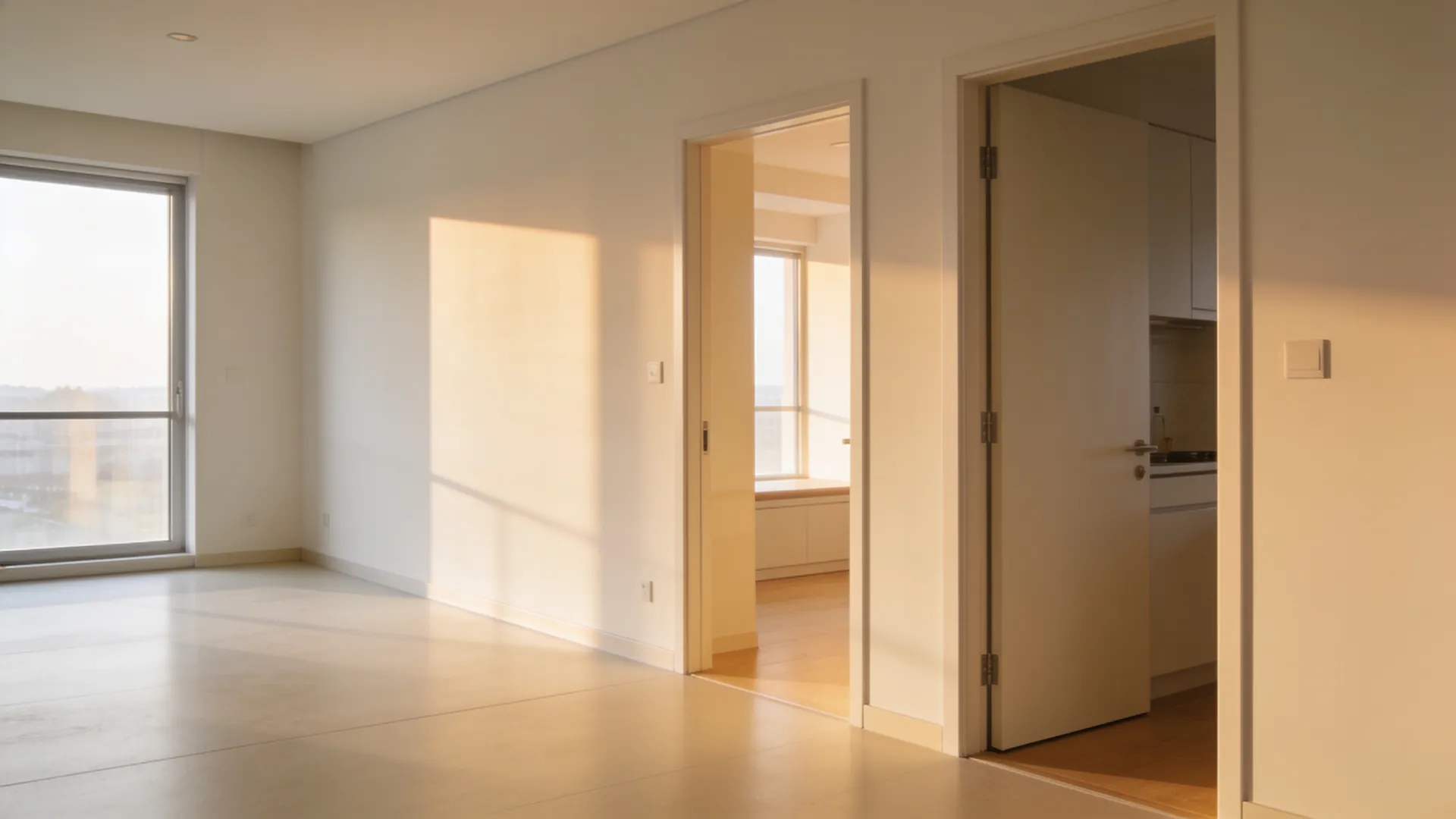
An apartment without steps, with wide doors and a step-free shower, can make daily life noticeably easier, whether in old age, with a disability, or simply for more comfort. But what does barrier-free (barrierefrei) mean exactly, and how does it differ from low-barrier (barrierearm) or wheelchair-accessible (rollstuhlgerecht)? We have been at home in the region and accompany prospective tenants in Düsseldorf and North Rhine-Westphalia. This guide explains calmly and clearly which features make up a barrier-free rental apartment, how to find a suitable home, what rights you have as a tenant, and which funding options currently come into consideration.
Are you an owner planning to let a property? Discuss preparing your property for letting, reaching suitable applicants and the steps through to handover. Tell us the property type, location and your timeframe. Discuss letting
What Does Barrier-Free Mean? DIN 18040-2 and the Key Distinctions
The term barrier-free is often used loosely in everyday life, but it has a technical basis. For apartments, the standard DIN 18040-2 describes the planning requirements for barrier-free construction. It distinguishes two levels: barrier-free usable as a general requirement for people with various impairments, and the additional, stricter R requirements for apartments that are to be fully usable with a wheelchair. Among other things, the R level requires greater door widths and more movement space.
It is important to distinguish three terms that are frequently confused:
- Barrier-free means meeting the requirements of DIN 18040-2, in other words a defined standard.
- Low-barrier is not a protected term. It describes apartments in which individual obstacles have been reduced without the full standard being met, for example only a step-free shower.
- Wheelchair-accessible corresponds to the elevated R requirements with sufficient turning areas for a wheelchair.
DIN 18040-2 is not itself a law. Through the State Building Code of NRW, through funding conditions, and through tenancy agreements, however, it becomes decisive in practice. If a provider advertises barrier-free, it is therefore worth asking which standard is specifically meant.
Typical Features of a Barrier-Free Rental Apartment
Whether an apartment is truly barrier-free shows in concrete details. These features are particularly relevant:
- Step-free access: From the pavement into the apartment there should be no steps, in other words a level building entrance or a ramp. Unavoidable thresholds are made very low and with bevelled edges.
- Lift: If the apartment is not on the ground floor, a sufficiently large lift is decisive, one that is also easy to use with a rollator or wheelchair.
- Wide doors: Doors should be wide enough to pass through comfortably with mobility aids. For wheelchair-accessible apartments, the R requirements provide for greater clear widths.
- Movement areas: In front of doors and in the bathroom there must be enough room to turn, and correspondingly more in wheelchair-accessible apartments.
- Step-free shower: A floor-level shower instead of a tub with a high entry, ideally with space for grab bars and a shower seat.
- Reachable controls: Light switches, handles, and window handles at a height that is easy to reach.
Depending on the situation in life, not all features are equally important. Someone who is steady on their feet but wants to avoid stairs has different priorities than someone who depends on a wheelchair. It helps to draw up a personal list of the points that really matter in advance.
How to Find a Barrier-Free Rental Apartment
Barrier-free apartments are a smaller part of the market, so a targeted search is worthwhile. These approaches have proven their worth:
- Use filters in property portals: Many portals offer search criteria such as barrier-free, step-free, or lift. Since this information is not always kept consistently, you should check the details later during the viewing.
- Housing associations and cooperatives: Municipal and cooperative providers in Düsseldorf and NRW often maintain senior-friendly or barrier-free housing stock. A direct enquiry and getting onto waiting lists can be worthwhile.
- Housing advice centres: In North Rhine-Westphalia there is a network of housing advice centres that advise free of charge on barrier-free living and adaptations and often know regional offers.
- Subsidised housing: For publicly subsidised, barrier-free apartments a housing entitlement certificate (Wohnberechtigungsschein) is often required. Clarify early whether you meet the requirements.
- Local networks: Some suitable apartment is never advertised widely. Contacts grown over decades and a good regional network can help to find offers here.
State your specific requirements clearly with every enquiry. This saves both sides time and leads more quickly to genuinely suitable apartments.
What to Watch for During the Viewing
A viewing is the best opportunity to verify the details from the listing. Take your time and ideally bring a tape measure. Pay particular attention to:
- The entire route: Check not only the apartment but the complete route from the street, through the building entrance, to the apartment door for steps and thresholds.
- Measure door widths: Measure the clear width of the entrance and interior doors, not just the door leaf but the actually free passage.
- Try out the lift: Do a rollator or wheelchair fit in comfortably, and is the cabin level with the corridor?
- Bathroom and shower: Is the shower really floor-level? Is there space for grab bars, and can the washbasin be approached from below?
- Movement space: Can you turn and move freely in front of the door, in the bathroom, and in the kitchen?
- Balcony and terrace: Is the transition to the outside step-free or at least low?
Have the provider confirm which standard is assured, and record important points in writing. This way you avoid misunderstandings about what barrier-free means in the specific case.
Your Rights as a Tenant: Barrier-Reducing Conversions under § 554 BGB
What if the apartment you found almost fits, but still needs a structural adaptation? Here § 554 BGB helps. Under it, the tenant can demand that the landlord permit structural changes to the rental property that serve use by people with disabilities, for example a floor-level shower, a door widening, or grab bars.
Several points are important here:
- A claim to permission, not to conversion by the landlord: The tenant may carry out the change but as a rule bears the costs of planning, conversion, and later restoration themselves.
- Limit of reasonableness: The claim does not exist if the structural change cannot reasonably be expected of the landlord even when weighing the tenant's interests, for example with serious interventions in the building fabric.
- Possible additional security: In connection with the structural change, the tenant may undertake to provide a special security. This is added to the normal deposit and is typically intended to safeguard the later restoration.
- Obtain permission beforehand: Do not convert on your own authority. Submit the request in good time and preferably in writing, with a description of the measure.
An agreement in the tenancy contract that deviates to the tenant's disadvantage is void under the law. In disputed questions, advice from a tenants' association or legal advice can be sensible. This guide does not replace individual legal advice.
Funding and Grants: Current Status 2026
Barrier-reducing conversions can often be funded. The funding landscape changes regularly, however, so you should check the current status directly with the relevant body before any measure.
- Care fund under § 40 SGB XI: Where a care level exists, the care funds can grant subsidies for measures that improve the living environment. The subsidy may not exceed an amount of 4,180 euros per measure. If several people in need of care live in a shared apartment, this amount applies per person in need of care, while the total amount per measure is capped at 16,720 euros. Funded are, for example, floor-level showers, door widenings, or stair lifts. Important: the measure must be applied for before it begins.
- KfW funding Age-Appropriate Conversion: The investment grant 455-B was temporarily suspended due to exhausted funds. As of the current status 2026, applications are possible again. Funded are individual measures for barrier reduction at 10 percent of the eligible costs and the higher standard Age-Appropriate Home at 12.5 percent. Tenants too can submit an application; a modernisation agreement with the landlord is recommended. In addition there is the KfW loan 159. Since conditions and availability can change, please always check the current information from KfW.
Note the sequence: applications must as a rule be submitted before the start of the work, and a measure that is already funded through care insurance cannot additionally be funded through KfW. A different, separate measure, by contrast, is possible.
Step by Step to the Right Barrier-Free Apartment
So that the search and any conversion proceed in an orderly way, a clear approach has proven its worth:
- Clarify the need: Note down which features are truly decisive for your situation, from step-free access to the form of shower.
- Search in a targeted way: Use portal filters, housing associations, cooperatives, housing advice centres, and regional contacts.
- View carefully: Check and measure the important points on site and have the standard confirmed.
- Coordinate the conversion: If an adaptation is needed, clarify early with the landlord the permission under § 554 BGB and the question of an additional security.
- Apply for funding: Submit funding applications to the care fund or KfW before the work begins.
Those who proceed in a structured way avoid costly mistakes and are more likely to find an apartment that truly fits their life. For questions concerning the search for a rental apartment in Düsseldorf and NRW, we are glad to be at your side.