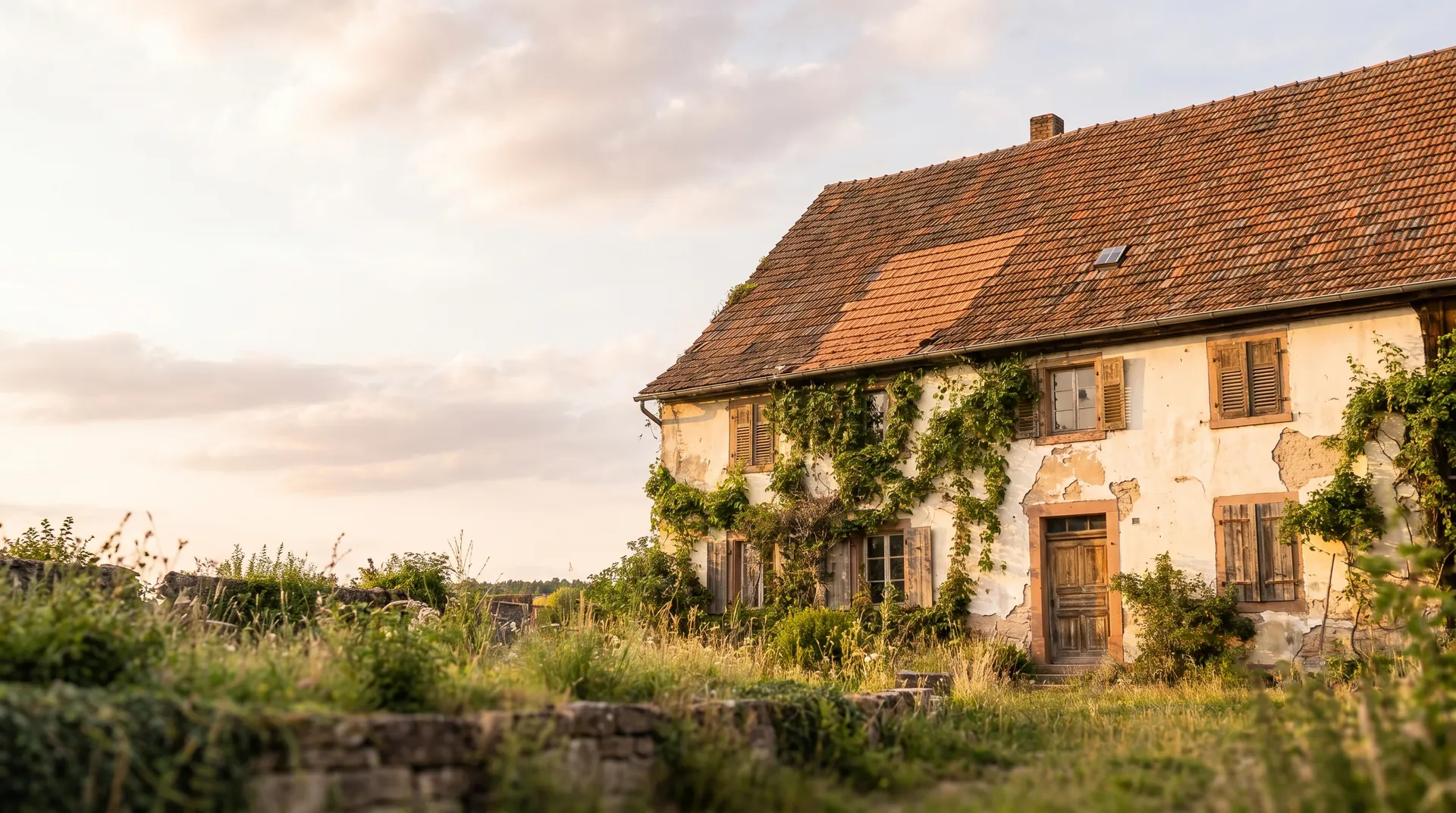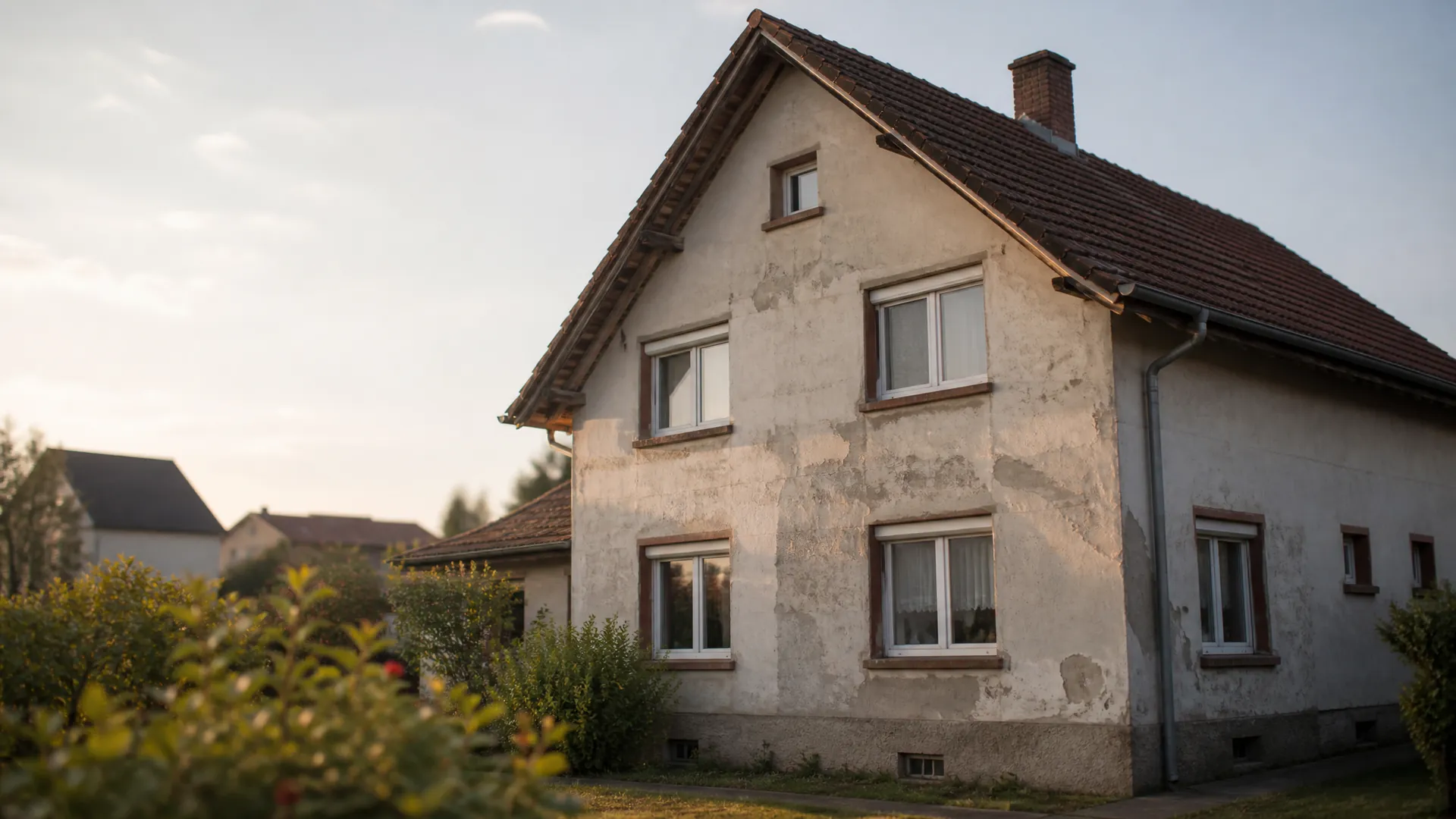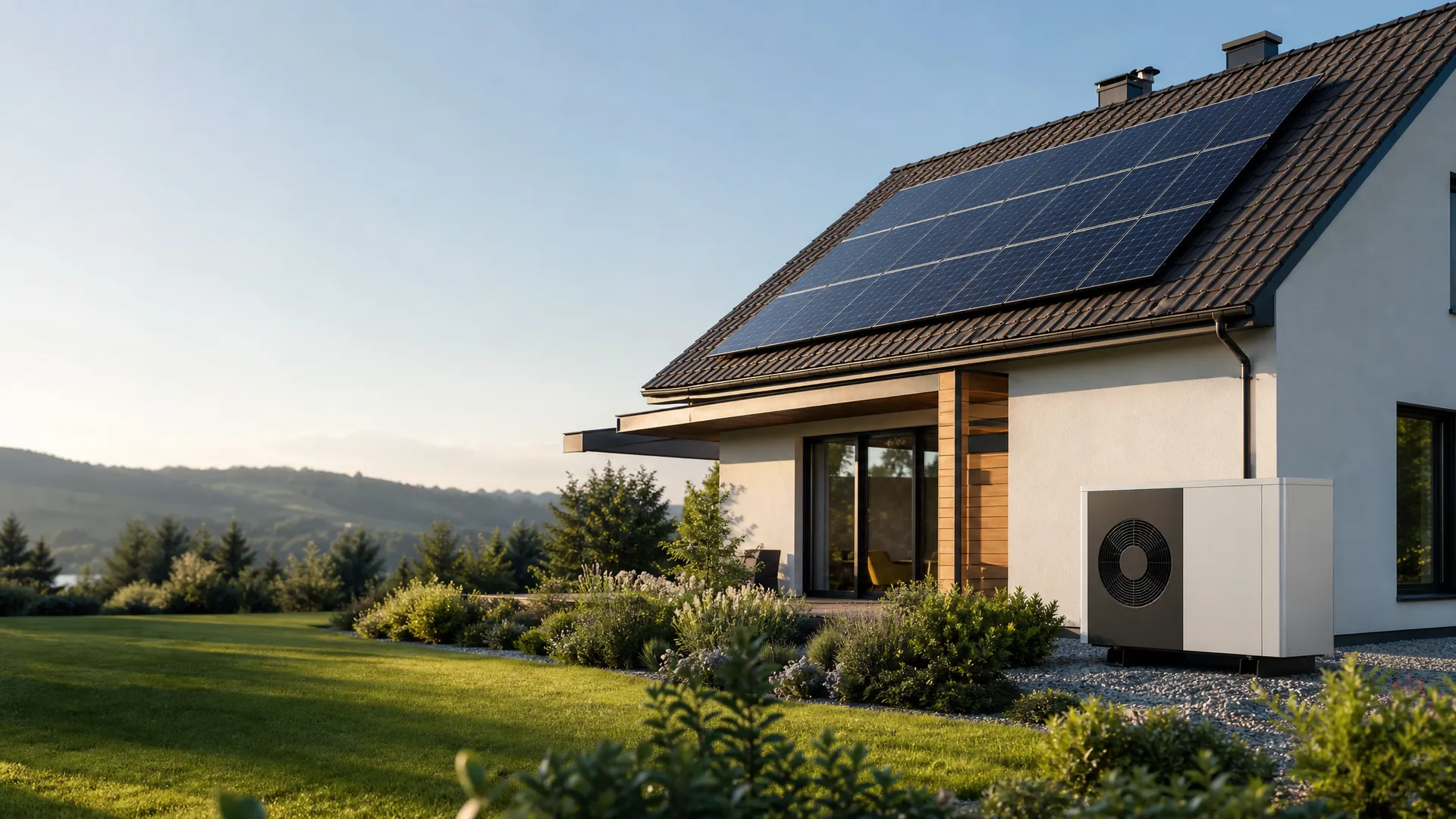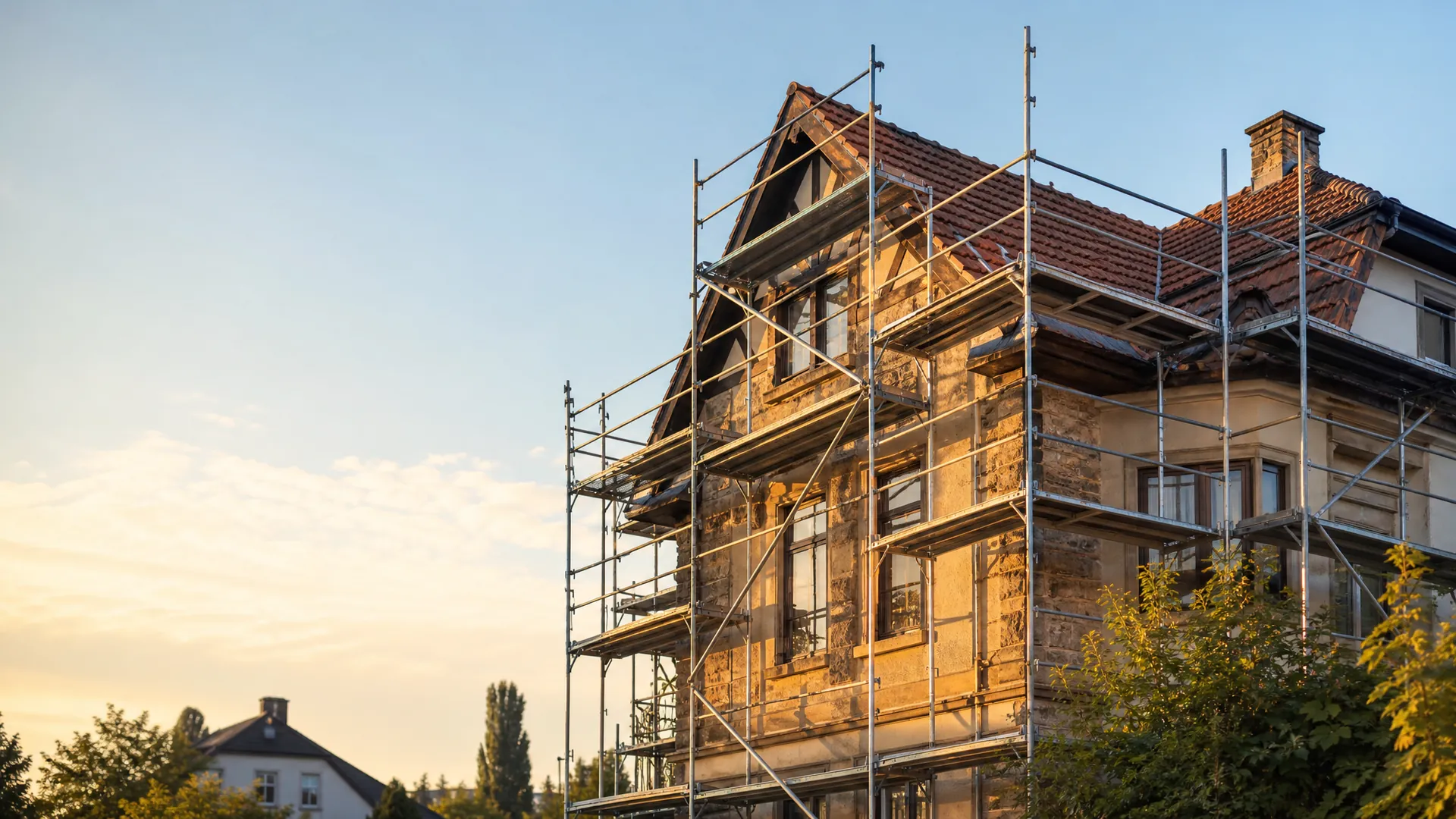
A core renovation (Kernsanierung) brings an ageing house back to a nearly as-new condition, from the building envelope to the building services. It is one of the largest investments owners ever make, and the cost ranges are correspondingly wide. We have supported owners in Düsseldorf and throughout North Rhine-Westphalia with their property and regularly value both renovated and unrenovated objects. This guide puts the realistic costs of a core renovation into context, explains the main cost drivers, the legal obligations under the Buildings Energy Act (GEG), the current funding programmes and the question of when renovating pays off compared with demolition and new construction.
Are you considering selling this property? Discuss your sale with us
What a core renovation covers
A core renovation goes far beyond a refurbishment. The house is stripped back to the load-bearing shell and then technically and energetically rebuilt. Which trades are involved in detail depends on the condition of the building; in a comprehensive core renovation these are typically the ones:
- Gutting: removal of internal plaster, non-load-bearing walls, floor coverings, old building services and bathrooms down to the load-bearing structure.
- Roof: renewal of the covering and substructure, often with new insulation and connection details.
- Façade and insulation: external insulation, usually as a thermal insulation composite system, with new render.
- Windows and external doors: replacement with modern, triple-glazed elements.
- Heating and building services: a new heat generator, often a heat pump, new distribution and, where applicable, a ventilation system.
- Electrical: completely new installation with sub-distribution, cabling and sufficient connections.
- Plumbing: new bathrooms, drinking-water and waste-water pipes.
- Floor plan: adjustment of the room layout, sometimes with interventions in load-bearing walls.
Added to this are interior finishing, screed, floor coverings, doors and painting work, which are often underestimated in the planning.
Cost benchmarks: per square metre and for a detached house
The costs of a core renovation can only be stated reliably as a range, because condition, the targeted energy standard and the fit-out vary greatly. As a rough orientation, the market quotes figures of around 600 to 1,500 euros per square metre of living space, and for comprehensive energy refurbishments with poor existing substance considerably above that. The following ranges are planning figures, not fixed prices:
- Rather simple core renovation (solid substance, standard fit-out): about 1,000 to 1,200 euros per square metre.
- Typical core renovation of an older building, energetically sensible: about 1,200 to 1,600 euros per square metre.
- Ambitious core renovation (poor condition, high efficiency standard, upscale fit-out): about 1,600 to 2,000 euros per square metre and more.
For a detached house of 120 to 150 square metres this means in many cases total costs of around 150,000 to 250,000 euros, and in demanding constellations even above that. For those who want a rough breakdown by trade: gutting is often between 50 and 150 euros per square metre of living space, a new electrical installation 80 to 150 euros, heating and building services depending on the system 150 to 300 euros, plumbing and bathrooms 150 to 300 euros. Roof and façade are calculated per component area; here 150 to 350 euros per square metre are usual. All figures are to be understood as guide values; the reliable basis is always an on-site survey and a concrete quotation.
The biggest cost drivers
Whether a core renovation ends up at the lower or upper end of the range is decided above all by a few factors:
- Targeted energy standard: a renovation to mere legal compliance is significantly cheaper than a renovation to a high efficiency-house level with thicker insulation, higher-quality windows and ventilation technology.
- Condition and year of construction: moisture damage, a dilapidated roof truss or settlement cracks drive costs up noticeably.
- Pollutants: asbestos, old mineral fibres or wood preservatives must be disposed of properly and at high cost.
- Building envelope: roof, façade and windows often account for the largest share in an energetically demanding renovation.
- Interventions in the structure: removing load-bearing walls, inserting steel beams or reinforcing ceilings can quickly run into five figures.
- Fit-out level: designer bathrooms, level-access showers, high-quality floors and smart-home technology make the costs rise considerably.
- Planning and ancillary costs: architect, structural engineering, specialist planning and energy-related construction supervision frequently add around 10 to 15 percent of the construction sum and are easily overlooked in per-square-metre prices.
Energy requirements: GModG replaces the former GEG rules
The Building Modernisation Act (GModG) has applied since 29 July 2026. Former sections 47, 48, 71 and 72 GEG have been repealed. The blanket 65-percent requirement for new heating systems and the former age-based operating prohibition can therefore no longer be derived from those provisions. Sale planning should use the current law rather than an older checklist.
Energy requirements still apply. Section 36 GModG now covers alterations to external building components, while section 69 addresses heating and hot-water pipes. It also specifies when a two-year period applies after a change of ownership. The actual work required depends on the building, its components and the conditions of the relevant provision. Have the condition, technical requirements and costs assessed for the particular property.
The amended law allows greater flexibility when choosing a heating system. This does not remove all operating requirements: the GModG also contains provisions on fuels and newly installed systems. Before investing, consider suitable technology, running costs and the intended period of use together. A sale alone is no reason to order a replacement system prematurely.
Funding: KfW, BAFA and the iSFP bonus
An energy-focused core renovation is publicly funded in Germany. The funding landscape is, however, not static politically and in budgetary terms, which is why you should check the specific conditions directly with the funding bodies immediately before applying. As of mid-2026, these are the central building blocks:
- KfW efficiency-house renovation (programme 261): anyone who renovates the house to an efficiency-house level can obtain a subsidised loan of up to 150,000 euros per residential unit with a repayment grant. The better the standard achieved, the higher the grant; the efficiency-house stages 85, 70, 55 and 40 are the usual logic.
- BAFA individual measures (BEG EM): individual steps such as insulation, windows, ventilation and other plant technology are subsidised with a basic funding rate of 15 percent. The eligible costs are 30,000 euros per residential unit and year.
- iSFP bonus: if the measures are implemented within the framework of an individual renovation roadmap (iSFP), there is an additional 5 percentage points of funding, and the maximum eligible amount rises to 60,000 euros per residential unit.
- Heating grant (KfW 458): Conditions changed on 21 July 2026. The basic rate is 30 percent; with bonuses and subject to eligibility, the total can reach 80 percent. KfW currently specifies 28,000 euros of eligible costs for the first residential unit. Applicant category, bonus eligibility and application date are decisive.
The right sequence is important: funding applications must as a rule be submitted before the contract is awarded, and an energy-efficiency expert is a prerequisite in many programmes.
Core renovation or demolition and new construction?
Beyond a certain level of effort, the question arises whether the core renovation is still worthwhile at all or whether demolition and new construction are the better choice. A widespread economic rule of thumb is: as long as the renovation costs remain clearly below about 70 to 75 percent of comparable new-build costs and the building substance is structurally sound, renovating is usually more sensible. This is not a legal standard but an orientation that has to be calculated through in the individual case.
In favour of core renovation are a sound substance, a floor plan adaptable with reasonable effort, the preservation of old-building charm, and the conservation of resources, because the grey energy bound up in the shell is retained. An important point is also grandfathering protection (Bestandsschutz): a legally erected house may continue to exist, even if it does not meet today's requirements. With a new build this protection is lost; the new build must fully comply with current building law and the development plan, which can restrict height, number of storeys or setback areas.
In favour of demolition and new construction are serious structural defects, the wish for a completely different floor plan or more space, and cases in which a sensible efficiency level can hardly be achieved economically. A look at the development plan and a professional substance assessment should stand at the beginning of every decision.
Effect on property value and the planning process
A successful core renovation usually has a marked effect on value. Buyers today pay close attention to the type and age of the heating, to the energy-efficiency class in the energy certificate, and to whether a renovation backlog is looming. A condition that is effectively as-new after the renovation is often valued on the market similarly to a much younger year of construction, provided the location and architecture are right. Above all, measures that reduce running costs and meet legal obligations pay disproportionately into value, and a comprehensive energy refurbishment can improve the energy-efficiency class by several stages.
For the process, this sequence has proven itself:
- Check the substance: have the structure, moisture, pollutants and roof load-bearing structure assessed by specialists.
- Concept and energy advice: define the target standard, ideally with an individual renovation roadmap.
- Calculate costs and funding: obtain quotations, factor in funding and submit applications in good time before the contract is awarded.
- Implementation: coordinate the trades, ideally with professional construction supervision.
Anyone who knows early on how the current condition and a renovation affect the market value plans on a sounder basis. This is exactly where our work comes in: we value renovated as well as unrenovated objects objectively and know the regional market from decades of experience.
If selling is an alternative to carrying out the renovation yourself, compare costs and possible proceeds for both routes. Selling a house that needs renovation covers condition records, defect disclosures and pricing.